HOME/TAXONOMY

The Taxonomy of Chinese Jade

Under modern mineralogy and China's national standard GB/T 16552 (Gems — Nomenclature), jade in the strict sense denotes two rock types only: nephrite of the tremolite–actinolite series, and jadeite jade (feicui), a pyroxene rock. In the traditional idiom, yu embraces every "stone that is beautiful". This volume orders the field by mineralogy first and cultural tradition second.

Primary Classification

The Two Great Families

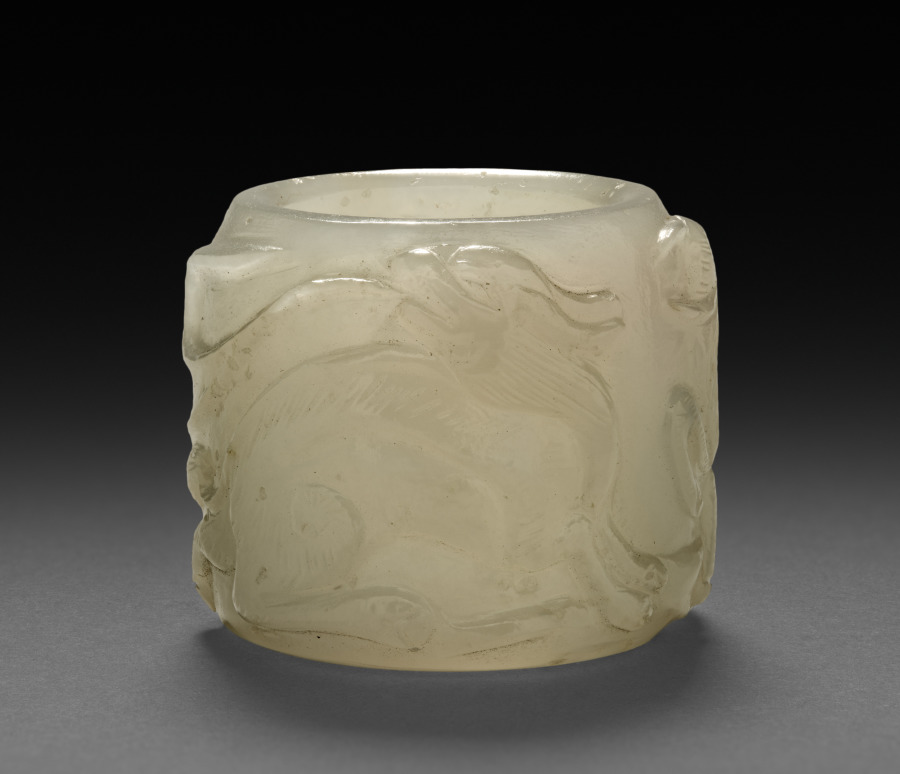
清代白玉扳指 Qing dynasty white jade thumb ring, Cleveland Museum of Art NEPHRITE · AMPHIBOLE

NephriteCa₂(Mg,Fe)₅Si₈O₂₂(OH)₂ · Tremolite–Actinolite

A dense aggregate of the tremolite–actinolite series whose felted fibrous texture makes it the toughest of natural gem materials. The most celebrated source is Hotan, Xinjiang — the Kunlun range and the White Jade River — with deposits also in Qinghai, Russia and Canada. The main body of China's eight-thousand-year jade tradition is nephrite.

Mineral groupAmphibole
Mohs hardness6 – 6.5
Specific gravity2.90 – 3.10
Refractive index1.606 – 1.632
LustreGreasy / waxy
Photo: white jade thumb ring, Qing dynasty · Cleveland Museum of Art (CC0)
THE NEPHRITE VOLUME
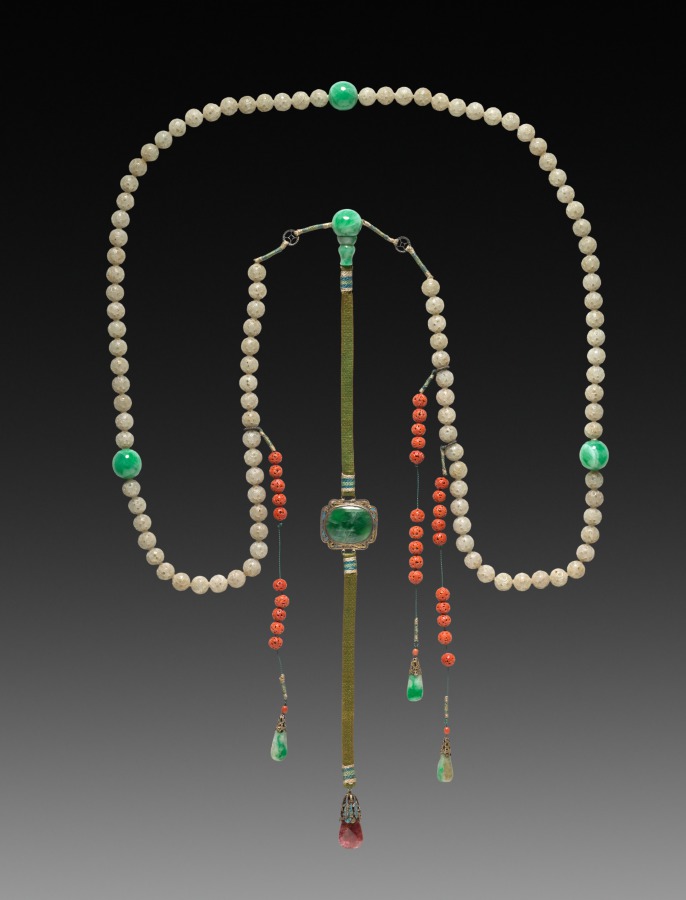
清代翡翠珊瑚朝珠 Qing dynasty mandarin necklace with jadeite and coral, Cleveland Museum of Art JADEITE · PYROXENE

Jadeite (Feicui)NaAlSi₂O₆ · Sodium Aluminium Pyroxene

A pyroxene rock composed chiefly of jadeite, with a granular-to-fibrous interlocking texture and a vitreous lustre; its palette runs from colourless through imperial green to lavender, red and yellow. Nearly all gem-grade material comes from the Uru River basin of northern Myanmar. It entered China along the Yunnan–Burma routes in the seventeenth century and rose to courtly pre-eminence in the mid-to-late Qing.

Mineral groupPyroxene
Mohs hardness6.5 – 7
Specific gravity3.30 – 3.36
Refractive index1.666 – 1.680
LustreVitreous
Photo: mandarin necklace of jadeite and coral, Qing dynasty · Cleveland Museum of Art (CC0)
THE JADEITE VOLUME
On the names: "soft jade" and "hard jade" are nineteenth-century mineralogical coinages marking a slight difference of hardness, not of quality — indeed nephrite's toughness is unmatched among gem materials. The national standards now use "Hetian jade" for all tremolite jade regardless of origin, and "feicui" for jadeite jade; this archive follows that usage.
The Broader Family

The Other Famous Jades

Xiuyan jade, Dushan jade and turquoise rank with Hetian nephrite as the Four Famous Jades of China; agate, rock crystal and lapis belong to the wider family of ornamental stones.

Xiuyan JadeSERPENTINE · LIAONING

Serpentine jade of Xiuyan, Liaoning — yellow-green, fine and waxy. It supplied the Hongshan culture's carvings and has been worked for over five thousand years, among the earliest of China's jade sources.

Dushan JadeANORTHITE ROCK · HENAN

A plagioclase rock from Dushan, Nanyang — many colours in one stone, ideal for polychrome carving. Present already among the finds at Yinxu; hence "Nanyang jade".

TurquoisePHOSPHATE · HUBEI

Finest from Shiyan, Hubei, sky-blue to apple-green. The dragon-form mosaic of over two thousand tesserae unearthed at Erlitou attests its ceremonial rank thirty-seven centuries ago.

Normative References

The National Standards

GB/T 16552GEMS — NOMENCLATURE

The charter of gem nomenclature, fixing the legal names "feicui" and "Hetian jade" and the labelling rules for treated material.

GB/T 16553GEMS — TESTING

Prescribes the methods of testing — refractive index, density, spectroscopy — by which natural is told from treated.

GB/T 38821-2020HETIAN JADE — CLASSIFICATION

Establishes the eight colour classes and occurrence types of Hetian jade — the direct basis of this archive's nephrite volume.

Frequently Asked

Taxonomy — Frequently Asked

01What is the difference between nephrite and jadeite?

They are two entirely different rock types. Nephrite belongs to the amphibole family — a tremolite–actinolite aggregate, Ca₂(Mg,Fe)₅[Si₄O₁₁]₂(OH)₂, Mohs 6–6.5, SG 2.86–3.06, with a greasy lustre prized when subtranslucent, sourced chiefly from the Kunlun–Altun belt of Xinjiang, China. Jadeite (fei cui) belongs to the pyroxene family — chiefly jadeite, NaAlSi₂O₆, Mohs 6.5–7, SG 3.30–3.36, with a vitreous lustre prized for transparency, and gem-grade material comes almost entirely from the Uru basin of northern Myanmar. In short: nephrite is judged by unction, jadeite by clarity; the first runs through eight thousand years of Chinese culture, the second rose to courtly rank only in the late Qing.

02Is "soft jade" really softer than "hard jade"?

The labels are nineteenth-century coinages marking a hair's difference of hardness — nephrite 6–6.5, jadeite 6.5–7 Mohs — not of quality. On the contrary, in toughness (resistance to impact and tearing) nephrite rates 9, the highest of all jades and second only to carbonado; jadeite and corundum rate 8. Measured Xinjiang nephrite averages 397.96 MPa in uniaxial compression, far above serpentine jade (224 MPa) or marble jade (65 MPa).

03What are China's Four Famous Jades?

Hetian jade of Xinjiang (tremolite), Xiuyan jade of Liaoning (serpentine), Dushan jade of Nanyang, Henan (a plagioclase rock) and turquoise of Hubei. Of these only Hetian jade falls within jade in the strict sense of national standard GB/T 16552; the other three belong, with agate, rock crystal and lapis, to the broader family of ornamental stones.

04What actually counts as jade?

Two standards apply. Mineralogically, and under China's national standards, jade means only two rocks: tremolite jade (Hetian) and jadeite jade (fei cui). In the Chinese tradition, Xu Shen's Shuowen Jiezi defines jade as "the fairest of stones" — any beautiful, workable stone qualifies, which is why serpentine, Dushan jade, turquoise, even agate and rock crystal are traditionally counted. This archive keeps both frames distinct and presents them together.