From the Kunlun it came, and warmed the world. This volume is compiled principally upon the monograph "Hetian Jade of Xinjiang, China" (Wang Shiqi et al., Science Press) and national standard GB/T 38821-2020, presenting in eleven chapters the nomenclature, composition, structure, physical properties, colour classes, occurrence, deposits, quality grading and authentication of nephrite. Book plates await licensing and are marked as placeholders.
The stone has borne many names across three millennia: "jade of the Yuzhi" and "jade of the Kunlun" in pre-Qin texts, "Yutian jade" after Zhang Qian opened the Western Regions, "Hetian jade" in its modern form since 1959. In the West, "nephrite" (kidney-stone) was coined in 1789; in 1863 Alexis Damour first separated nephrite from jadeite by chemical analysis, and the paired terms entered Chinese scholarship in 1918 through Zhang Hongzhao's Shi Ya. The "soft/hard" labels mark a hair's difference of hardness (6–6.5 vs 6.5–7 Mohs) — never of quality.
The national standards evolved in four steps — from GB/T 16552—1996 (listing "nephrite") through the 2003 edition (adding "Hetian jade" as a non-geographic name) and 2010/2017 revisions, to the dedicated GB/T 38821—2020, which fixes eight colour classes: white, greenish-white, qing, spinach-green, yellow, sugar, black and cui-green jade. This archive follows that canon, and distinguishes Hetian jade in the broad sense (all qualifying tremolite jade, origin-neutral) from the strict sense — the 1,300-kilometre Kunlun–Altun belt of Xinjiang, from Tashkurgan east to Ruoqiang.
Nephrite is a dense aggregate of the tremolite–actinolite series, tremolite typically above 95%, formula Ca₂(Mg,Fe)₅[Si₄O₁₁]₂(OH)₂. By the IMA amphibole rule, Mg/(Mg+Fe)≥0.90 defines tremolite: white, greenish-white and yellow jade are nearly pure tremolite; qing deepens as iron rises; spinach-green and the "black-qing / black-bi" jades are dominated by actinolite.
Accessory minerals, though under 5%, number over twenty — diopside, calcite, apatite, epidote, chlorite, zoisite, graphite, allanite, prehnite, phlogopite, serpentine, quartz, plagioclase, pyrite, magnetite, chromite and secondary Fe–Mn oxides. They account for the trade's "bone", "cotton" and "black spots": white flecks are mostly epidote and coarse tremolite porphyroblasts; black dots are chromite in spinach jade (Cr₂O₃ up to 45–65%) and graphite in "blue-flower" black jade. Two parent-rock types exist: altered Ca–Mg carbonate (dolomitic marble — yielding white, qing, yellow, sugar, black) and altered ultramafic rock (serpentinite — yielding spinach green).
Four structural families: crystalloblastic (by grain size — micro-coarse >0.1mm, micro-fine 0.01–0.1mm, cryptocrystalline <0.01mm, the last most typical of Xinjiang nephrite; by arrangement — felted-interwoven, micro-fibrous, whisk-like, fibre-bundled, radial and porphyroblastic, the felted fabric of randomly interlocked fibres marking the finest, most even jade); metasomatic (pseudomorph, relict, corroded, rimmed); dynamic (oriented, deformed — shear stress refines the grain and lifts quality, but excess stress causes foliation); and secondary-infill (dendritic, net-veined, tiger-skin, vortical — iron minerals along fissures, whose enrichment makes sugar jade).
At hand-specimen scale the fabric is chiefly massive (even and dense); foliated fabric from late directed stress splits readily and demands caution when buying rough. The finer the fibres and the tighter their interlock, the greater the toughness — the structural root of nephrite's supremacy.
Data below are the book's laboratory measurements on dozens of documented Xinjiang samples (spot refractometry, hydrostatic weighing, micro-indentation, rock-mechanics testing).
| Property | Measured range | Notes |
|---|---|---|
| Refractive index | 1.60 – 1.62(avg 1.61) | White 1.60–1.61; qing & spinach up to 1.62; graphite-black slightly lower |
| Specific gravity | 2.86 – 3.06(avg 2.96) | White 2.94 → qing 2.97 → spinach 3.00 → black-bi 3.02, rising with iron |
| Mohs (from Vickers) | 5.29 – 6.90(avg 6.07) | White highest (avg 6.39, max 6.90); spinach lowest (5.86); finer fibre = harder |
| Relative toughness | 9 / 10 | Highest of all jades, second only to carbonado; jadeite & corundum rate 8 |
| Compressive strength | 368 – 445 MPa(avg 398) | "Extremely hard" rock class; cf. Xiuyan 224, dense quartzite jade 317, marble jade 65 |
| Tensile strength | 21.6 – 62.9 MPa(avg 42) | Exceeds the 36 MPa ceiling of common rocks; striking when fissure-free |
| Lustre / diaphaneity | Greasy; subtranslucent | The greasy lustre is nephrite's signature, mutton-fat its acme |
Sugar-jade and white-jade cat's-eyes — the book records the first chatoyant sugar and white nephrite, from the Jinshan mine at Qiemo: parallel tremolite-asbestos fibres, cut en cabochon, throw a bright mobile eye-line. All previous nephrite cat's-eyes came from serpentinite-type spinach deposits (Taiwan, Sichuan, Russia); this is the first from an altered-marble deposit, opening a new prospecting direction.
Colours divide into primary (white, qing, yellow, black, green) and secondary (sugar). Pure tremolite is colourless; as Fe²⁺ replaces Mg²⁺ at the M1/M3 lattice sites the hue deepens from white through greenish-white to qing — nephrite's fundamental law of colour. Each class below carries a documented exemplar and its colour genesis.
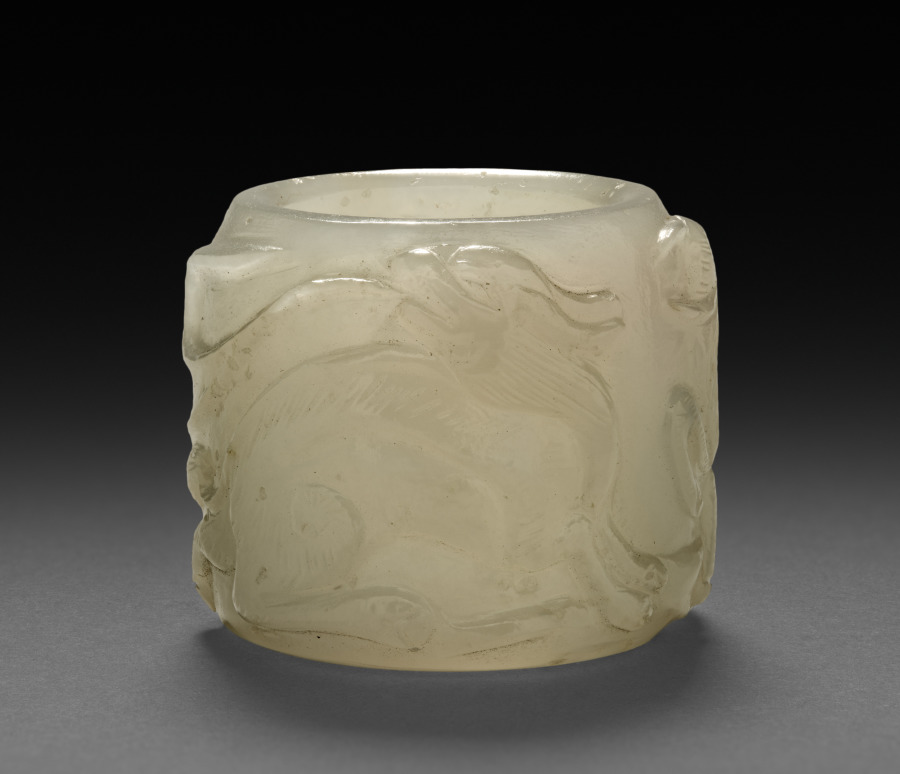
Defined by "four highs" — unctuousness, whiteness, fineness, purity — with a faint warm cast allowed. Almost exclusively from seed pebbles; the sole mountain material conceded mutton-fat rank is the "95 Yutian" lode of 1995. No national standard yet exists; the monograph calls for one.
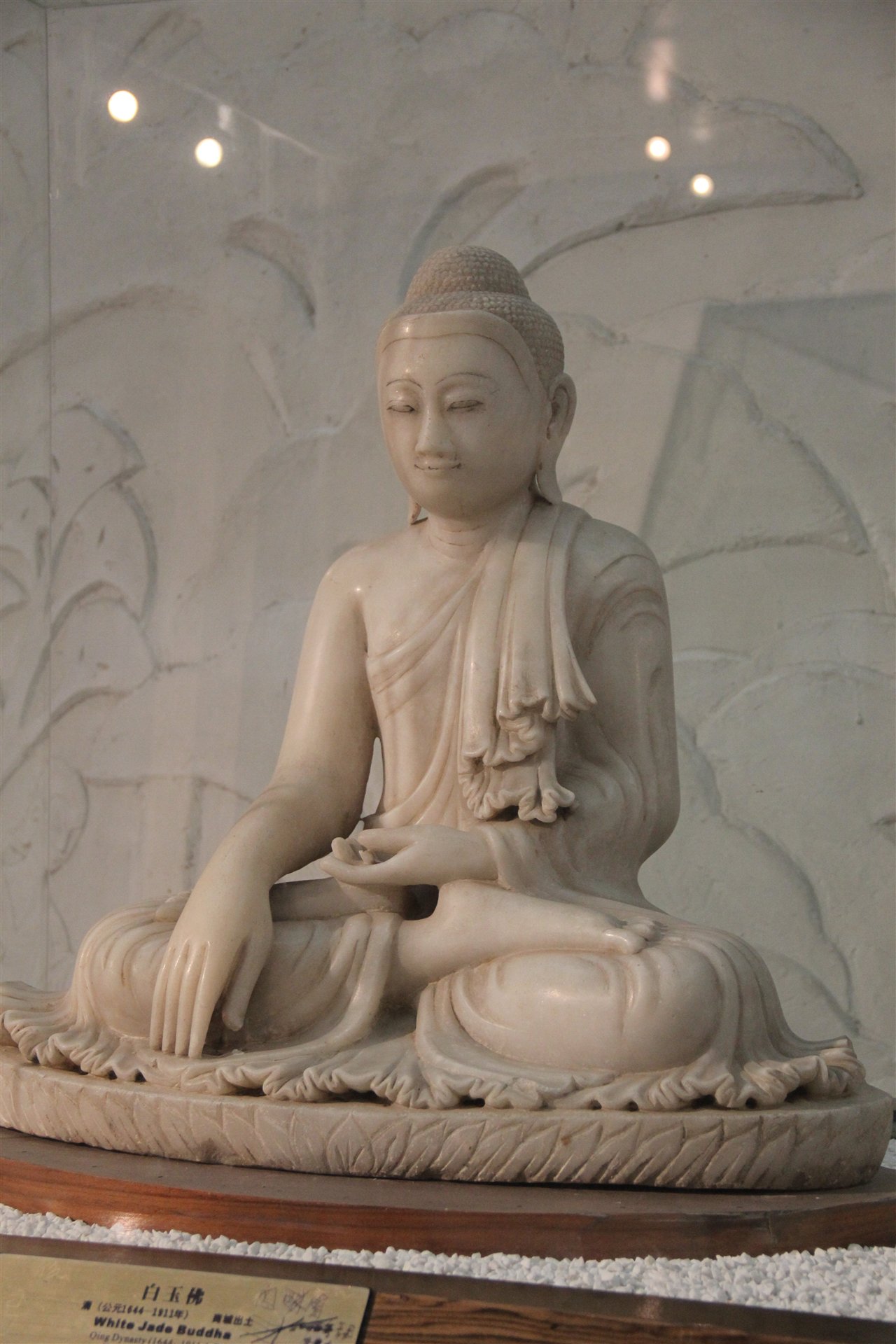
Nearly pure tremolite with minimal iron substitution (no 3658 cm⁻¹ Raman band). Folk grades: fish-belly, pear-blossom, moon white. Its purity and density give the highest hardness of all classes (avg 6.39).
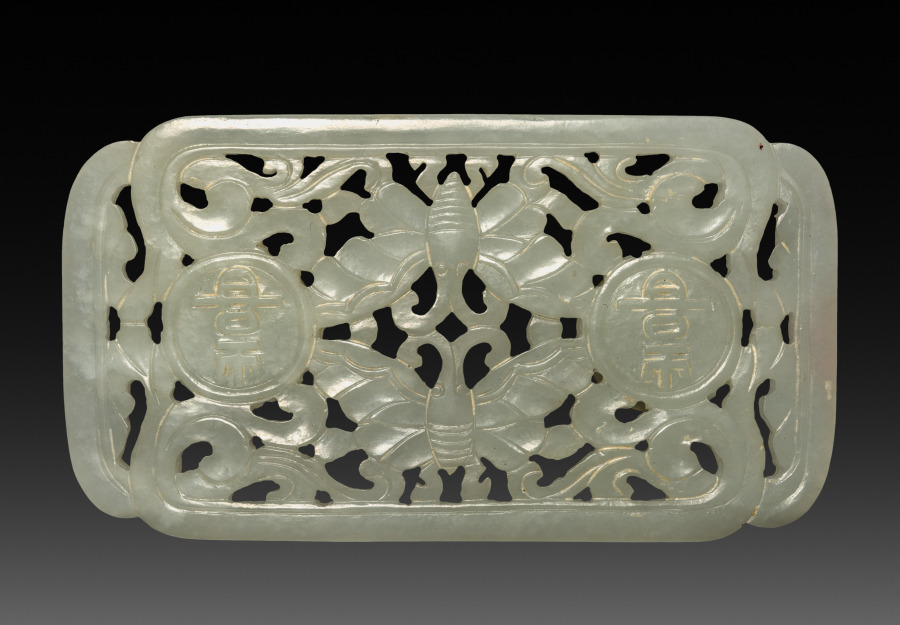
The transition class between white and qing, ranked separately for its abundance. Moderate Fe²⁺ substitution (3675/3661 cm⁻¹ bands emerging). The most numerous among surviving works.
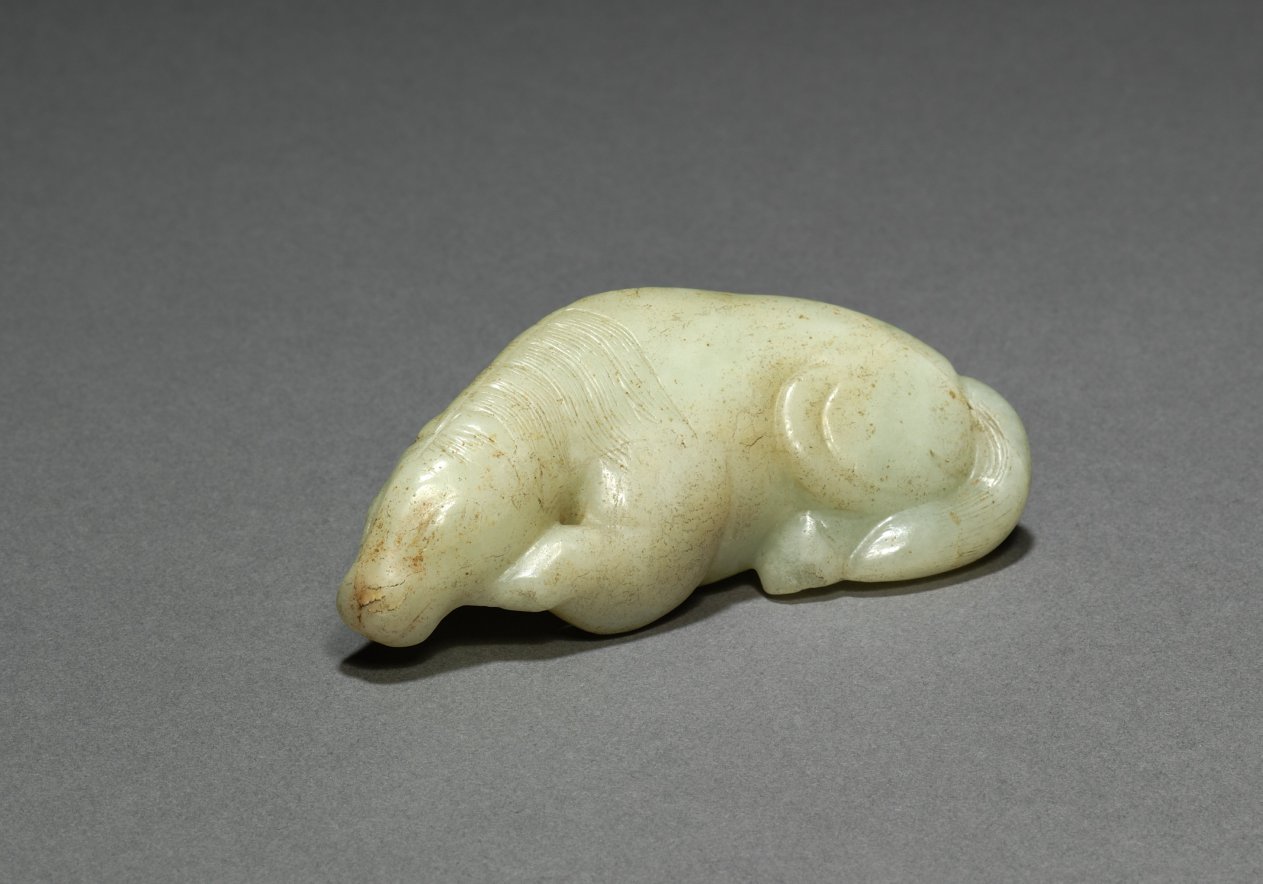
Deepest Fe²⁺ substitution (Fe rising from 1,336 ppm in white to 17,309 ppm in dark qing); the most abundant class, in great block sizes. Folk names run from shrimp to willow to crab-shell green; "oleaster green" ranks first.
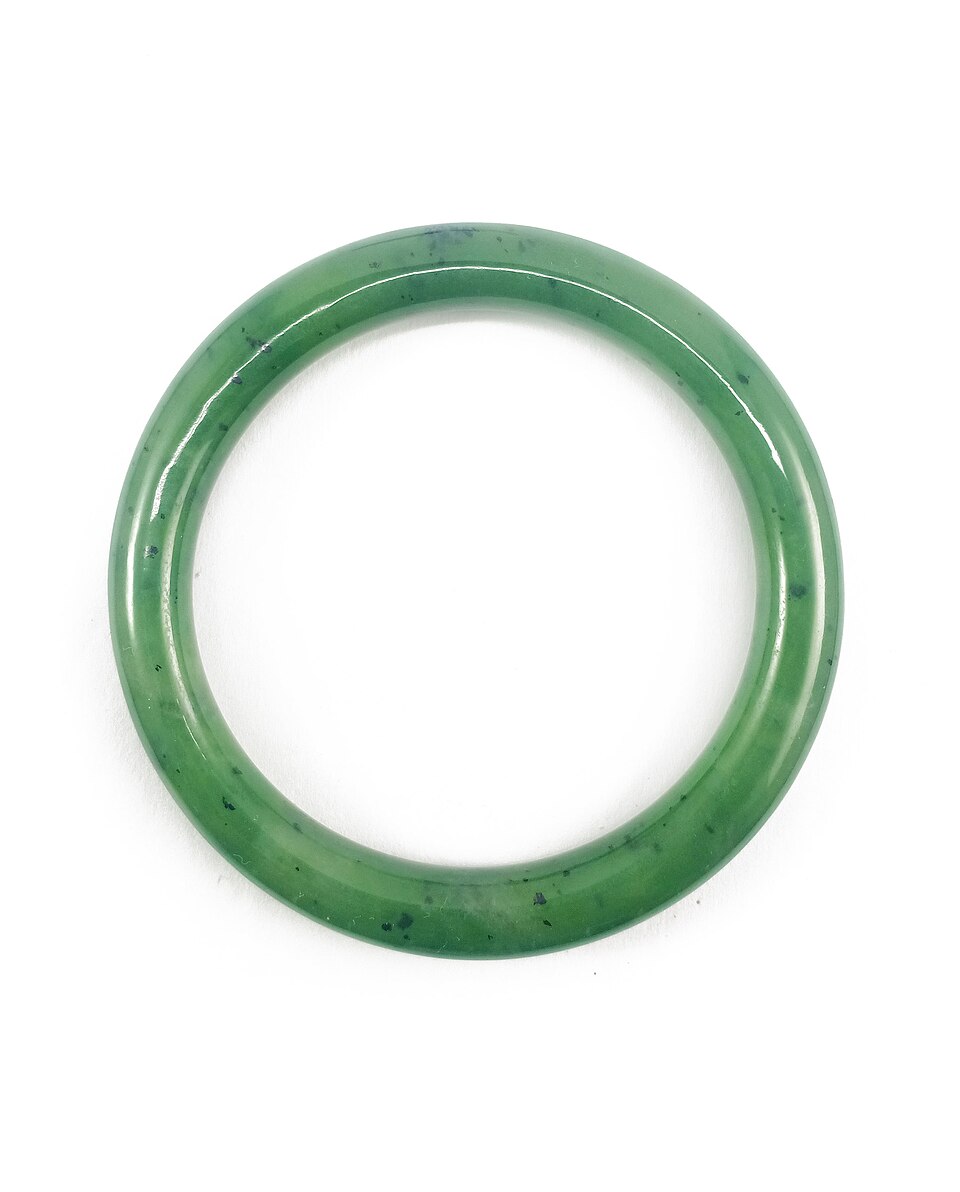
The only class born of altered ultramafics; actinolite-dominant, its green led by Fe²⁺ with Cr, Mn, Ni assisting, chromite dots its birthmark. Densest of all (avg 3.00). Market rule: for spinach alone, the more translucent the better.
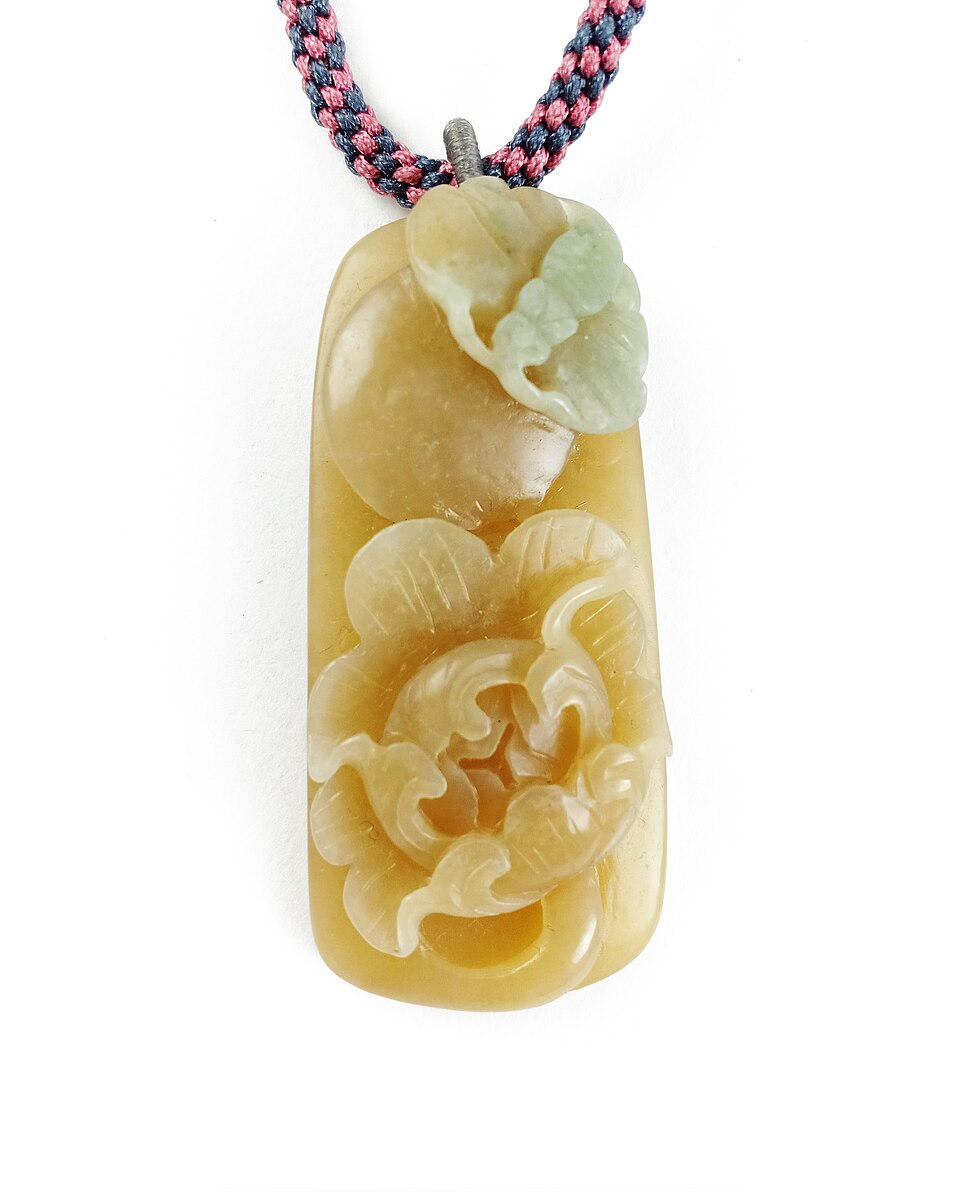
A primary colour, chiefly from Ruoqiang; Fe and Mn jointly at work, the yellow strengthening as Fe³⁺/Fe²⁺ falls. "Chicken-fat yellow" rivals mutton-fat in worth. Once seed-only; Ruoqiang "huangkou" mountain and Gobi material now supplements it.
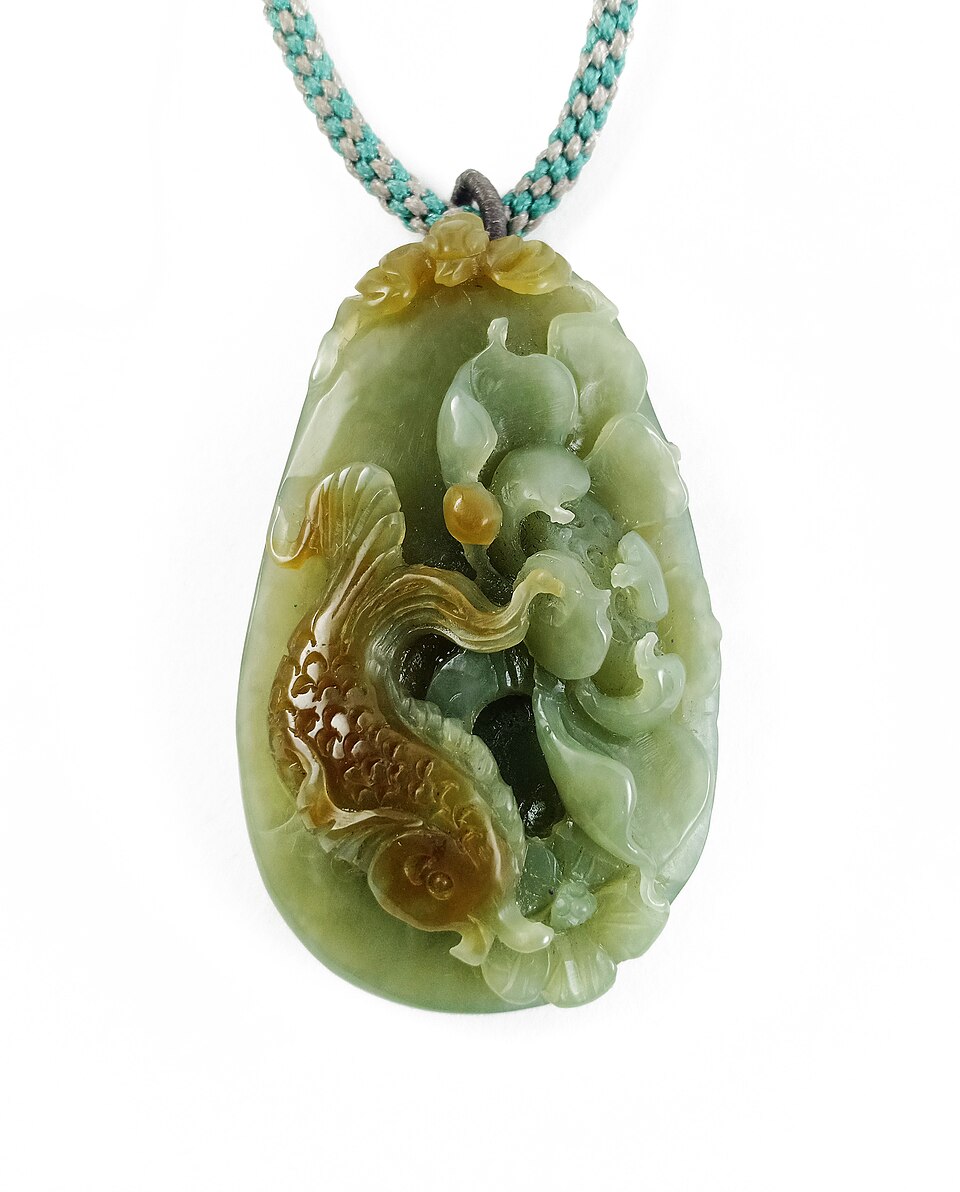
The sole secondary colour: XRD confirms goethite FeO(OH) staining along grain boundaries and micro-fissures. Local standard grades by sugar coverage: trace <5%, present 5–30%, sugar-X 30–85%, sugar jade >85%. Carvers turn the tint to advantage; the sugar-white of Tashsayi, Qiemo, is the most celebrated.
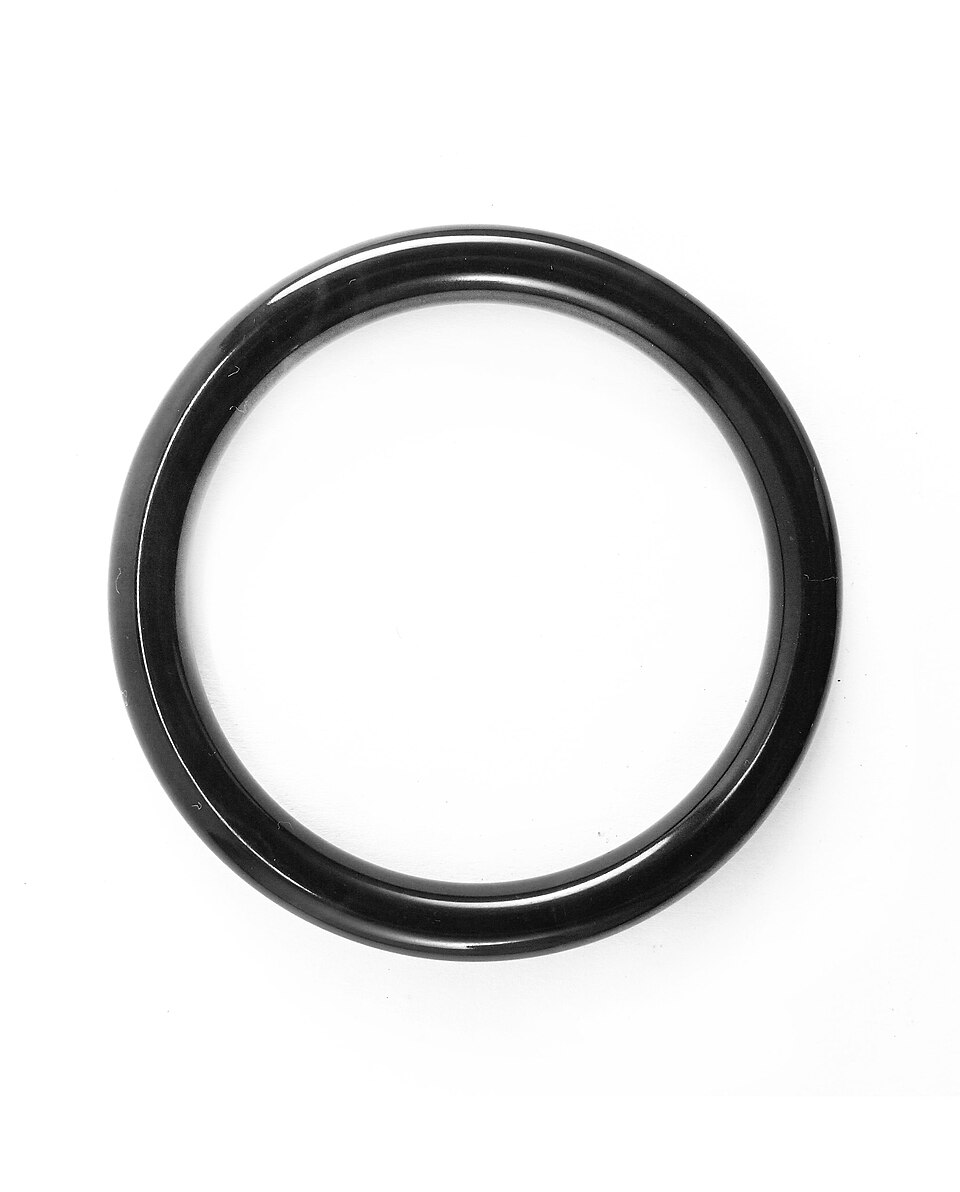
Market "black jade" is threefold: graphite black (graphite inclusions; ≥85% is full black, less is "blue-flower" — dot, streak or cluster ink; pyrite-bearing pieces are "gold-star"); black-qing and black-bi (iron-rich actinolite, glowing qing or green against strong light). Density, hardness and transmitted colour tell them apart.
Once the lode is unroofed, weathering and transport spin a graded lineage of secondary deposits. Quality being equal, value ranks: seed > Gobi > shanliushui > mountain.
Quarried from the lode, in weathered (net-veined brown rinds) and fresh sub-types; large angular blocks of variable grade, the stock of monumental carving.
Residual-slope material (residual, colluvial and glacial): lightly worn, sub-angular, locally skinned. Glacial boulders come off high-glacier fronts — famously Heishan at Hotan, and a 60-tonne qing boulder below Muztagh's north slope.
River-milled for aeons — dragged, rolled, saltated — until only the dense heart survives as a streamlined pebble. Its passport: the skins (autumn-pear, jujube-red, tiger, lamp-soot) and surface textures (orange-peel, "sweat pores", impact marks). Chiefly from the middle-lower White Jade and Karakash rivers, their terraces and fan palaeochannels.
Slope material flushed onto piedmont gravel plains and sand-blasted for millennia into rippled satin skins — pomelo, orange, roe or satin grained; flat and sub-angular (mean length:thickness 3.8). Pishan yields most, Qira's southern belt is most famed; the Gobi setting is unique to Xinjiang.
The Kunlun–Altun belt is the eastern reach of the trans-Asian Turkey–Afghanistan–Pakistan gem belt: 1,260 km from Tashkurgan to the Qinghai border (1,380 km along the arc), 20–150 km wide, bowed around the southern Tarim rim. Drawing on the national resource survey, the monograph divides it into three sub-belts — West Kunlun, East Kunlun and Altun — comprising 39 ore-cluster groups and 134 known deposits and occurrences.
The lodes formed by magmatic-hydrothermal contact metasomatism — fluids from intermediate-acid intrusions reworking dolomitic marble at the outer contact; most lack true magnesian skarn, so "skarn-type" is a misnomer. Spinach green forms instead where fluids rework serpentinised ultramafics.
Mines 65–67 on the upper Keriya, worked for two centuries; the Republican-era "Qi Family Pit" stood here, its white jade the finest of lode material. Nearby Saidikulamu yields cui-green.
Source of the legendary "95 Yutian" of 1995 — the only lode material conceded mutton-fat rank, now exhausted; Qihakule's blue-flower black jade is its other signature.
The belt's sole "super-large" cluster (5,000-tonne class), capital of sugar-white; Jinshan nearby yields the cat's-eyes. Mirdai (Yecheng), Tatelike-su (Qiemo), Muztagh spinach and Ruoqiang yellow each hold their own fame.
The monograph grades by eight factors — colour, texture, lustre, diaphaneity, clarity, fissures, weight, occurrence — into four classes overall. Judge colour by noon daylight: lamplight flatters, as the proverb warns.
| Factor | How it is judged |
|---|---|
| Colour · hue | Value order: white > yellow > green > black/sugar > qing; then saturation (white/black the fuller the better, chromatic hues best at 7–8/10), brightness, trueness, evenness |
| Texture | Cryptocrystalline — grain felt rather than seen; four ranks from very fine to coarse |
| Lustre | Greasy lustre reigns (strong/medium/weak); waxy and porcelain follow. Nine millennia of "warm and unctuous" mean precisely this |
| Diaphaneity | Opposite to jadeite: subtranslucency is ideal — too clear loses the unction. Two exceptions: graphite black (the blacker the better) and spinach (the clearer the better) |
| Clarity | Flaws come as dots (chromite, graphite), patches and cotton wisps; the fewer and fainter the better, four ranks |
| Fissures | "Nine seeds in ten are cracked"; distinguish open fissures from healed stone-lines and water-lines. Beware dealers calling cracks "lines" |
| Weight | Quality equal, bigger is dearer — fine jade sells by the gram, middling by the kilo, common by the tonne |
| Occurrence | Seed > Gobi > shanliushui > mountain; first-class white calls for >5 kg lode or >2 kg seed, strong greasy lustre, subtranslucent, clean and crack-free |
Five counterfeit families haunt the market: look-alike stones, glass and plastic imitations, faked seed pebbles, faked Gobi pieces, and composites. Each betrays itself.
| Stone | Lustre / texture | R.I. | S.G. | Mohs | Quick tell |
|---|---|---|---|---|---|
| Nephrite (reference) | Greasy · cryptocrystalline | 1.61± | 2.95± | 6–6.5 | Splintery fracture, hefts heavy |
| Quartzite jade | Vitreous · granular | 1.54± | 2.64–2.7 | 6–7 | Too translucent, light in hand |
| Chalcedony | Vitreous · cryptocrystalline | 1.53–1.54 | 2.65± | 6.5–7 | Conchoidal fracture, semi-transparent |
| Serpentine (Xiuyan) | Waxy–vitreous | 1.56–1.57 | 2.57± | 2.5–6 | A pocket knife scratches it |
| Marble ("Afghan jade") | Vitreous · granular | 1.48–1.65 | 2.7± | 3 | Fizzes violently in dilute HCl |
| Albite jade | Vitreous · granular | 1.52–1.53 | 2.6–2.63 | 6± | "Foam" specks against the light |
| Brucite jade | Vitreous · cryptocrystalline | 1.57± | 2.3–2.6 | 2.5± | Feather-light, scratches at once |
| Wollastonite jade | Vitreous · cryptocrystalline | 1.60–1.61 | 2.78–2.91 | 4.5–5 | Closest mimic on paper — but soft and never unctuous |
Tumbled lode rough with dyed "skin". True skin seeps along fissures, fading inward, its sweat-pores irregular; fake colour floats, pooling harshly in hollows, with parallel polish marks on the rounding. Beware half-genuine "beautified" pebbles — inspect the whole stone.
True Gobi stones are flat and sub-angular (length:thickness ≈ 3.8), their etch-grain — pomelo, orange, roe or satin — varying face to face, with fine healed cracks and silt lodged in the hollows; machine-blasted fakes show uniform pitting and no silt, and a whole batch of rounded "Gobi" is itself the warning.
Composites hide poor stone under good: hunt the join and the glue — cement fluoresces violet-blue under UV. Glass "jade" (a lineage running from Warring-States glass to the Yuan court's imitation-jade bureau) shows bubbles, conchoidal fracture, vitreous flash, and warms too fast in the hand.
Today's nephrite comes chiefly from Xinjiang, Qinghai, Xiuyan (Liaoning), Lake Baikal and Chuncheon (Korea) — geologically near-identical and beyond routine instruments. The monograph's eight-point visual method resolves about 70%; the rest needs trace-element and isotope work. Certificates never state origin, so the premium rides wholly on the eye.
| Origin | Colour habit | Lustre & feel | Signature tells |
|---|---|---|---|
| Xinjiang | White, greenish-white, qing; cui-green rare | Fine, moist, oily, "congealed" — strongest greasy lustre of the five | Least cotton; small thin-skinned seeds; Gobi material found nowhere else |
| Qinghai | Greyish white; frequent cui-green and smoke-violet | Moist but not oily, "watery", markedly more translucent | Abundant water-lines its hallmark; no seed pebbles known |
| Xiuyan (Liaoning) | White rare; yellow-white and yellow-green dominate | Fairly unctuous, sometimes waxy | Well-developed sugar; thick-skinned "river-milled" pebbles — the Hongshan culture's source |
| Russia (Baikal) | Strikingly white — but a "dead" white | Oily yet not moist; partly waxy | Cotton in clots and "crab-claw" wisps; heavy sugar grading into the flesh |
| Korea (Chuncheon) | White tinged yellow or grey-green, seldom pure | Weakest of the five: waxy, resinous, dull and directional | "Rice-porridge" cotton (relict carbonate); no sugar, no seeds |